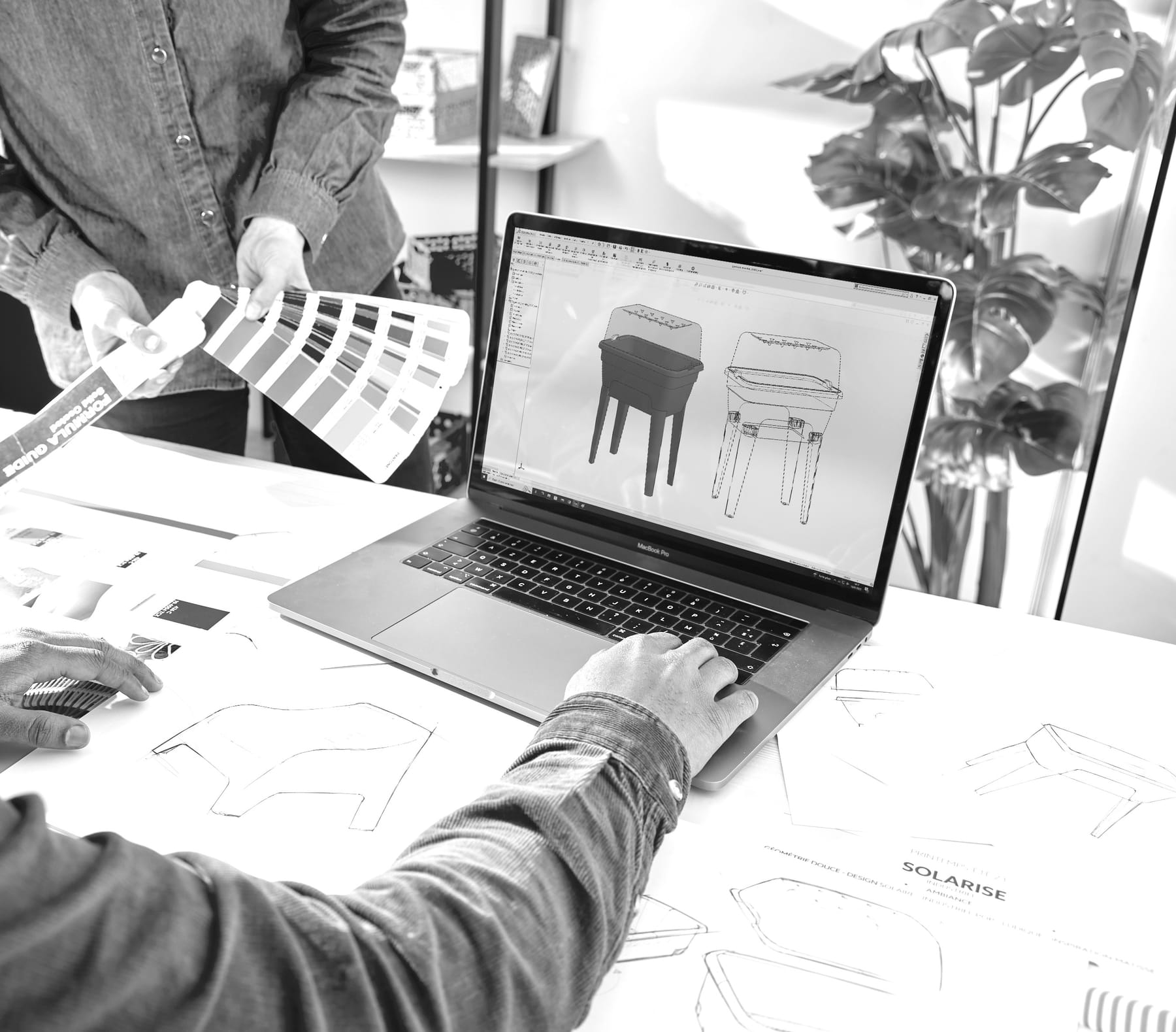
Judge on an image rather than an intention
A photorealistic render represents a fraction of the cost of a prototype and allows decisions to be made earlier, with greater certainty and before a wider committee.
About
As an independent industrial designer, I have spent fifteen years working with brands, retailers and manufacturers on high-volume consumer products.
My involvement spans the full development cycle: market and usage analysis, concept definition, 3D modelling, colour, material and finish selection, and follow-up through to factory sample approval.
The categories concerned — garden furniture, toys and outdoor, tableware, household products, fit-outs — are defined by tight pricing and contested shelf space. Every design decision translates immediately into unit cost, shipping volume or return rate.
That is where the essential value of design lies: creating a product that is desirable to the consumer, defensible in front of a buyer, and manufacturable under real factory conditions.
Three convictions
A photorealistic render represents a fraction of the cost of a prototype and allows decisions to be made earlier, with greater certainty and before a wider committee.
Process, unit cost, assembly and packing do not work against design: they form its framework and, often, the source of its best solutions.
A coherent collection owns the shelf, extends across price levels and renews itself without starting from scratch each season.
Tools & skills
Partners









Let’s talk
Describe the project in a few lines: category, deadline, intended process. I will come back with a reading of the subject and a proposed framing.